Painter of the mystical, otherworldly, sensual, and whimsical.

I'm a painter living and working in the beautiful finger-lakes region of Western New York State. I am also an avid gardener and nature lover, so the lush green rolling hills, gentle streams, and majestic lakes that surround my home in this world often appear in the fantasy worlds of my paintings.

Many of the pieces draw inspiration from folk tales, myths and legends. These "teaching tales" were what drew us together around our hearth-fires for centuries, and I believe those stories still carry power.

I enjoy looking at these ancient tales, through my eyes, and painting what I see, no matter if it's beautiful or disturbing. But what's more fun is when others can see those same paintings and find something within of value that speaks to their soul directly. I do not plan for this, but am honored when it happens, and, oh, yes, do love hearing about it every time that it happens. It reminds me that maybe we are not so different after all.

Glad to meet you, and please enjoy the paintings!
Showing posts with label history. Show all posts

Monday, January 6, 2014

Firearms: Yes, it's a women's issue (I have opinions.)

Above: Lyudmila Mykhailivna Pavlichenko (July 12, 1916 – October 10, 1974), 
a Soviet sniper during WWII. She is credited with 309 kills, 
and regarded as the most successful female sniper in history. 
(Photo courtesy of wikimedia commons.)


Russian Female Snipers in WWII
were feared by 
combat trained German troops. 
(So much for guns being a macho-man only sport!) 

In fact, there were approximately 2,000 female snipers in the Red Army, of whom about 500 survived the war. Lyudmila Pavlichenko (pictured above), Nina Lobkovskaya, and Klavdiya Kalugina (who was only 17 at the start of her military service in 1943) were among the thousands of women who put themselves in the line of fire for Mother Russia.  They were armed with slightly more accurate but less-rugged sniper rifles (German: Scharfschützengewehr or SSG), than their conscripted brothers: an upgrade from the cheaper assault rifle.

While I have openly said that we, as a culture, really ought to consider just how "universal" that "right" to own a firearm really is (Hey, we do have a licencing process to drive cars, showing that we're not going to act like a damned fool when behind the wheel, correct? Most NRA members that I've talked to understand gun safety and the rules of firearms so well that they could teach a gun safety course themselves, and agree this is reasonable.) ...guns are also a women's right's issue, in that they truly become the great equalizer.  I am not a small woman (or a woman who should ever own a firearm) but I understand the fear that my petite friends feel when at risk of being beaten, abused, or raped.  Cornered and out-massed by 200 lbs. of angry pot-roast is no place to be.

...but one bullet is one bullet.  Nothing says "I'm not getting raped (mugged/ beaten) today!" like a large-caliber round to the center chest.  Simple, eloquent, and to-the-point.  The vast majority of rape cases will never go to trial, the majority of those that do will never be convicted, and, if you grew up in the United States, you probably know the rest. Dead men can't become repeat offenders.  If she is fighting for her life, no further argument is necessary.

Wednesday, December 25, 2013

Have Yourself a Leyendecker Christmas


"Artists to Watch Out For" is one of the favorite things that I do for the Blogosphere.  It's my gift to the world, and my way of sharing historic and contemporary art and artists that I love but that you may not have seen in a standard college art class... and if there's one that says "20th Century Christmas," it's J.C. Leyendecker.

I'm not alone.  When fellow painter and blogger Clinton T. Hobart listed his favorite Christmas illustrations, I saw three different Leyendeckers made the list, with one earning the added distinction: "one of my favorite illustrations ever." A realistic painter himself, Hobart writes, "J.C Leyendecker has always been my favorite for Holiday Illustration."

Leyendecker's impact on the Golden Age of Illustration is immeasurable.  His influence on the later Norman Rockwell is something often forgotten by history. Saturday Evening Post cover illustration was almost synonymous with this man until Rockwell followed in his footsteps.  The entire opus of his life's work includes over 300 covers for the Post alone...  Obviously, the holiday covers are a very small tip of a giant iceberg.

 This Flickr Collection is copyrighted, but enjoyable.

Thursday, November 21, 2013

Love for John Donne's "Broken Heart"

Poet and satirist John Donne, a contemporary of William Shakespeare and Queen Elizabeth I, is a long-time personal favorite. I feel his work has an intensity that remains unmatched to this day. This piece sings to me. 


The Broken Heart 
 He is stark mad, who ever says,
That he hath been in love an hour,
Yet not that love so soon decays,
But that it can ten in less space devour;
Who will believe me, if I swear
That I have had the plague a year?
Who would not laugh at me, if I should say,
I saw a flask of powder burn a day?

St. Luke, Portia. "Melancholia."
Ink on paper with digital color.
Ah, what a trifle is a heart,
If once into love's hands it come!
All other griefs allow a part
To other griefs, and ask themselves but some;
They come to us, but us Love draws,
He swallows us, and never chaws:
By him, as by chain'd shot, whole ranks to die,
He is the tyrant pike, our hearts the fry.
If 'twere not so, what did become
Of my heart, when I first saw thee?
I brought a heart into the room,

But from the room, I carried none with me:
If it had gone to thee, I know Mine would have taught thine heart to show

More pity unto me: but Love, alas,
At one first blow did shiver it as glass

Yet nothing can to nothing fall,
Nor any place be empty quite,
Therefore I think my breast hath all
Those pieces still, though they be not unite;
And now as broken glasses show
A hundred lesser faces, so
My rags of heart can like, wish, and adore
But after one such love, can love no more.

~ John Donne (1572 – 1631)

Tuesday, May 14, 2013

The Schizophrenic who Painted Cats


Finding Louis Wain has been my "You Are Not Alone" of the week. 

Louis Wain's deeply fascinating life and resulting body of work provide a surprisingly intimate view into the perceptions of the schizophrenic mind.  Remember, he lived between 1860 and 1939, in an era when the study of psychiatry was in its infancy. However, watching the progress of his life's work is to watch the process and "degeneration" of the mind that results from this "chronic mental disorder."


His early work is remarkably realistic.  Whimsical., creative, and fun, yes, and, to a point, these are "realistic" cats... or, at least, recognizable as cats by the average child.  Since childrens' books show cats behaving as human beings, I won't say that "furry art" is strange. In addition, "Reynard the Fox" appeared in English literature in 1481, so I can't even claim that Louis Wain invented this.


Above: "Katzenklub" by Louis Wain


According to the website End of the Game, "Wain was always fascinated by cats, but when his wife was diagnosed with cancer, he started drawing them in silly situations to amuse her. His drawings grew in popularity and were featured on greeting cards and in magazines and newspapers. Life was good, that is until his wife died of said cancer and he started to lose control of his mind."


Above: "Snow" by Louis Wain


Current research shows that a schizophrenic usually doesn't truly "loose their mind" because of a specific incident.  It's a more reasonable guess that Louis' earliest symptoms begin manifesting in adolescence. According to the Mayo Clinic, "In men, schizophrenia symptoms typically start in the teens or 20s. In women, schizophrenia symptoms typically begin in the 20s or early 30s. It's uncommon for children to be diagnosed with schizophrenia and rare for those older than 45."

Put bluntly, by 45, the symptoms have become noticeable a long time ago.  These days, if you're a schizophrenic, I'd really like to hope somebody has noticed and begun to get you the help you need before age 45.  Given how much more bearable life can be with the right mix of lifestyle changes and good meds, I'd like to hope anybody with this could get help as soon as possible.  However, this was a different era, so Louis wasn't actually diagnosed until 57.  
 The chances that there was an "onset of his disease at 57," are highly unlikely.  Looking at the work that was created before that diagnosis, I feel it's possible, even easy, to see beginning to show that slow slide long before he was actually diagnosed.

Above: "Katzen 1" by Louis Wain
Below: Louis Wain's images as they are frequently presented in psychology text books.


This is the point where psychologists become interested, and both psychology textbooks and the internet abound with images of Louis Wain's "schizophrenic cats."  Popular history tells us that he believed he was just painting cats until the end of his life.  End of the Game's article, "Schizophrenic Cats," is a good, short read, even if I feel their understanding of schizophrenia is limited.

It's been so wonderful to look at the world that through the eyes of Louis Wain. What he left behind feels like a note from the universe telling me, "You aren't the first person to feel this way, and you won't be the last. He looked into the void and saw this.  Imagine what you can do."

Saturday, December 22, 2012

Blessed Solstice, my friends!


Above: St Luke, Portia. Holly King Oak King. 

2010. Ink on tinted paper highlighted in white. 
Original Available.
(Also available as a poster or as note cards from Zazzle.)


Fix yourself a cup of hot chocolate while I tell you an old story from my homeland, with piece of artwork from a couple of years ago... 

The tale of the Holly King and the Oak King is a timeless myth with origins that run throughout the British Isles.  The Holly King was believed to be crowned every year on the Summer Solstice, only to cede the throne every year come the Winter Solstice to the young Oak King. The Oak King takes his rightful place, knowing he, too, will have to relinquish that same throne in his time.  So it is that the seasons turn, winter to summer and back again.

Monday, November 19, 2012

Strange WWII Propaganda posters


So, I'm taking a break from my current animation project to work on the next piece of creating a world for a video game.  This particular piece is creating propaganda posters for inside the world, as a way to flesh out the darkly oppressive look and feel of AErligheim.  As a way to research what makes good propaganda great, I began wading through the dark and unapologetic back-eddies of the internets in search of the truly unique propaganda imagery from during WWII.  I love the skill that allowed a masterful graphic designer to drive a point home, in one, punchy frame, and I do not care, for this exercise, how crazy the message itself was.

...which is good, because, man, it gets strange.  It gets very, very strange.  Like with these two handy broadsides about how to avoid chemical weapons:


Remembering all the times Grandmother told us not to waste food...


...and, for all of my friends who actually are Canadians...  (Love the hat!)


Monday, November 5, 2012

First Yuletide Holiday Card Design is up....


c. Portia St. Luke 2009


More will follow. Please enjoy, share, and pass them along!

My favorite parts of this holiday are the more traditional European "Yuletide," and "Father Christmas" parts of it.  I especially love the warm firelight, so this one has a very old, English poem called "the Yule Log" printed on the inside. It was written by the English poet Robert Herrick (1591-1674), and Zazzle was able to print it in a beautiful Old English typeface.

Here's the poem:

The Yule Log
Come, bring with a noise,
My merry, merry boys,
 The Christmas log to the firing;
While my good dame, she 

Bids ye all be free,
 And drink to your heart's desiring.
 With the last year's brand 

Light the new block, and 
For good success in his spending, 
On your Psaltries play, 
That sweet luck may 
 Come while the log is tending. 

Friday, September 28, 2012

Saturno Butto: A Florentine Master in the Modern World


Above: by Saturno Bruno

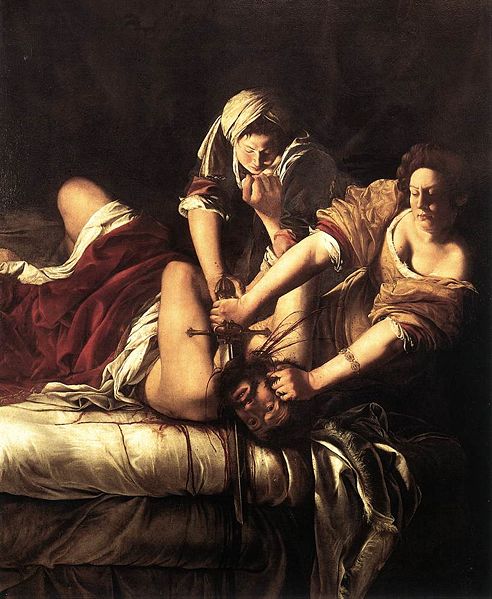
High Renaissance and early Baroque painting holds a fascination for me in a way than no other artistic period or style possibly can. The meticulous attention to detail, light, shadow, reflected counter-light, textures, drapery, anatomy... For me, the art world reached its apex in the 1500's - 1600's.  Caravaggio has always been a favorite.  Artemisia Gentileschi, his contemporary, was influenced by his work, and rose to a level that was clearly on-par with his brilliance. Often, I feel I could work my entire life with the hope of being that good.
(Pictured right: Caravaggio's "Judith Beheading Holofernes," 1598.
Left: Artemisia Genteleschi's treatment of the same subject, 1614) 

Finding Saturno Butto was like finding a light in the middle of a very dark world. Here is a living painter who has the skill to paint as well as either Caravaggio or Gentileschi ever did, while throwing disturbingly modern twists such as medical equipment, modern lingerie, and weapons, into what could otherwise be a flawless reproduction of the Renaissance Masters.  Far from being a run-of-the-mill copyist, his work has its own dark, uneasy feel to it... elements of psychology and theology intertwine to create a so-real-you-could-touch-it mixture that is, somehow, both sacred and profane at the same time.

Unfortunately, his main portfolio site is possibly the most Flash-heavy piece of web-construction I've run into, making it very slow or difficult to navigate if your computer is not running at peak efficiency.  It's worth taking the time to look through, but, sadly, that may mean time, and lots of it.   Thankfully, the interwebs are vast, and he can be found just as easily on FaceBook.  The on-line gallery von Scaramouche was able to provide this intriguing interview with the Master himself. 

Von Scaramouche describes "a man who, with the exception of a decade related to art studies, never left Bibione, a small Venetian city alongside the sea, where he lives and works," and yet can be called "one of the most captivating figurative painters around today."

For a real treat, find a time when you will not be interrupted and music by 
Claudio Monteverdi (16th century) or Giovanni Battista Pergolesi (18th century)   (This is very easy to do if you have Pandora.)  Mute your phone.  This world can wait.  Listen to the music, and loose yourself in the dark and twisted beauty of the world that lives within Saturno Butto's paintings.   

(Left and below:  various paintings by Saturno Butto) 


Friday, September 21, 2012

Who is the most persistent person who has ever lived?


Above: "Amontillado I" c. Portia St. Luke, 1997
(Pastel and charcoal on paper)
Slightly before 1960, Dashrath Manjhi's wife died without any treatment, because the nearest town with a Doctor was 70 km away from their village in Bihar, India. Unfortunately, most of that distance was over a hill in between the village and the town. If it was removed, the trek would have been one-tenth of the distance. Dashrath did not want anyone else to suffer the same fate as his wife. So he did the unthinkable: he single-handedly carved a 360-foot-long (110 m), 25-foot-high (7.6 m) and 30-foot-wide (9.1 m) road by cutting a mountain of Gehlour hills with a hammer, chisel and nails working day and night for 22 years from 1960 to 1982. 

This hand-chiseled passage reduced the distance between Atri and Wazirganj blocks of Gaya district from 70 km to just 7 km.


In 1979, in northern India's Assam region, after flood waters had receded, Jadav "Molai" Payeng, only 16 then, found the place dotted with the dead reptiles. That was the turning point of his life. The teenager began re-seeding the barren sandbar. 30 years later, the spot today hosts a sprawling 1,360 acre of jungle that Payeng planted single-handedly.

22 others, including Cambodian Aki Ra, who personally removed and cleared over 50,000 land mines by himself from Siam Reap region of Cambodia, and Simon Wiesenthal - the Nazi Hunter who dedicated most of his life (post WW II) to documenting and helping hunt down Nazi criminals from all over the world - comprise a list of the most persistent people to have ever lived.

Each story told is amazing, and speaks to the power of perseverance and the will of the human spirit. To read their stories, and vote on which one(s) you feel to be the most persistent person (people) in the world, I encourage you to visit Quora and read the answers to the question, "Who is the most persistent person who has ever lived?"